Most people sadly recall 7th October 2023 as the date of the worst massacre of Jews since the Second World War.
But that day also has its own special name; Shemini Atzeret, literally “the Eighth Day of Stopping,” and always follows immediately after the seven days of Sukkot. The Torah does not assign it any specific mitzvah other than the bringing of offerings. There is no sukkah, no lulav, no special rituals, only the quiet designation that “on the eighth day you shall linger on”.
The Baal Shem Tov explains that Shemini Atzeret is the day when the relationship between G-d and Israel is revealed in its purest essence. During Sukkot, seventy sacrifices were brought on behalf of all the nations, highlighting Israel’s universal mission. But on Shemini Atzeret, only one bull was offered, symbolizing the singular love between G-d and His people.
It is not a public festival but a private embrace. G-d is saying: “I had you share My blessings with the world, but now I want one day with just you.”
In the Torah itself, there is no mention of Simchat Torah. The Torah only designates the day after Sukkot as Shemini Atzeret. The joy of completing the Torah cycle and dancing with the scrolls developed gradually over centuries.
In Israel during Talmudic times, Jews would complete the Torah reading every three years (or three and a half).
In Babylonia, however, the custom arose to finish the entire Torah once a year, completing it on Shemini Atzeret.
Over time, the Babylonian annual cycle spread and became the universal custom. At first, the completion of the Torah was marked with special aliyot, festive meals, and communal joy that expanded into dancing with the Torah scrolls until eventually it acquired its own distinct name, Simchat Torah.
In Israel where there is only one day of Shemini Atzeret, Simchat Torah and Shemini Atzeret are the same day, while in the Diaspora, the first day remains Shemini Atzeret proper, while the second day became known exclusively as Simchat Torah.
From a Chassidic perspective, this historical unfolding itself reflects a spiritual truth: the hidden intimacy of Shemini Atzeret naturally gave birth to the open celebration of Simchat Torah. What began as a quiet, inward day blossomed into a festival of communal joy.
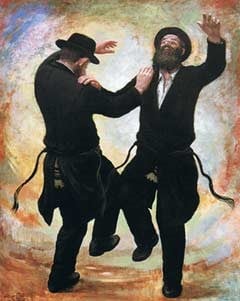
On Simchat Torah, we complete the yearly Torah cycle and immediately begin again. But the celebration is not expressed through study or intellectual mastery. Instead, we dance with the Torah, holding it closed and covered, rejoicing not in its details but in its essence.
Chassidic masters emphasize that this shows the depth of the bond between the Jew and Torah. Our connection is not dependent on understanding, on brilliance, or on scholarship. At the core, we love Torah because it is G-d’s will and wisdom, and we are bound to it as a child is to a parent.
True relationship with G-d is not only in the awe of Rosh Hashanah, the forgiveness of Yom Kippur, or the joy of Sukkot. The deepest bond is when
G-d says, “Just stay with Me one more day,” and we respond, “We just want to be with You.”
That bond is then carried into Simchat Torah, when the essence of the Jew and the essence of Torah unite in a dance that defies reason.
It is the embrace of Shemini Atzeret that becomes the dance of Simchat Torah, the inner intimacy overflowing into outer joy.
I believe it was the BBC that aired a documentary called “We Will Dance Again” about the harrowing brutal assault on partygoers at the Nova Music Festival, by Hamas on 7 October 2023- Shemini Atzeret 5784.
The essential message of Shemini Atzeret is that Jew never needs to, nor should ever, stop dancing.
It is precisely at a time of challenge and pain, that we need to muster our inner faith and strength to keep on dancing and to look very deep within ourselves to discover our own personal intimate relationship with G-d.
Wishing you all a truly joyous Shemini Atzeret/Simchat Torah.